August 25, 2008

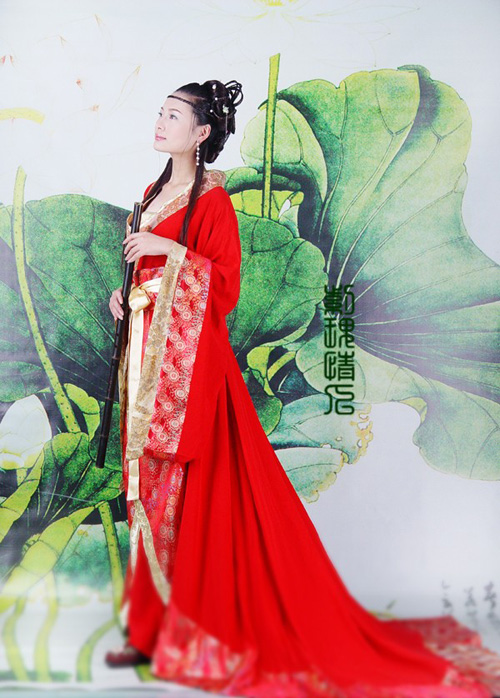
Han fu - Chinese Costume


Stylish, beautiful, and downright cool, Chinese clothing has influenced everything from the Japanese Kimono and Korean Hanbok to outfits in movies like Star Wars. Research indicates that Chinese clothing started to take shape during the Xià 夏 dynasty (2200 BC),

and lasted until the Míng 明 dynasty (1368-1644).when it was forcibly replaced by Manchu styles (1644-1911). Pre-Qīng clothing is referred to as Hàn fu (汉服 sometimes called 衣裳 Yī shang), or the traditional dress of the Han Chinese people. Many people equate “traditional” Chinese clothing to the popular Qí páo (旗袍) or Cheongsam (长衫), however these are Manchu styles and not the form of clothing worn by Chinese people for thousands of years.

Han Fu is buttonless clothing, features wide sleeves and layered loose robes


Nowdays, there is many Han Fu fans all over china, and it becomes more and more. many fans wear Han Fu everydays, at work, at home, on buses, and tell people the story about Han Fu.


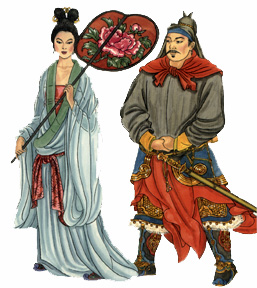
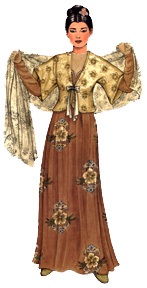
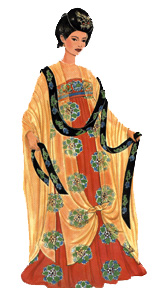
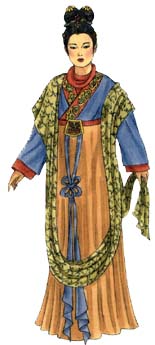
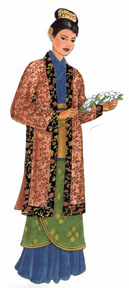
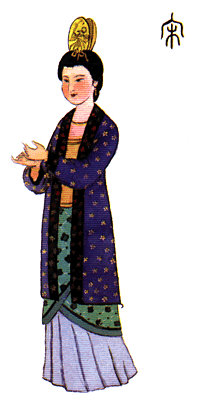
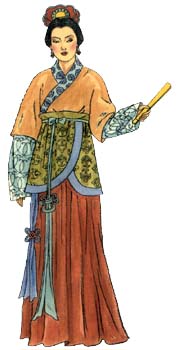
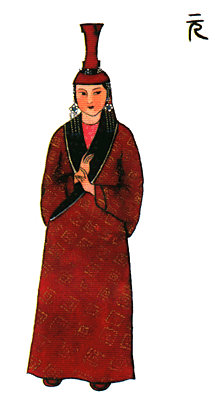
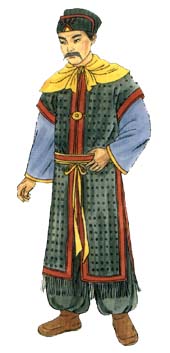
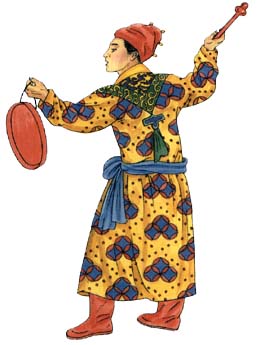
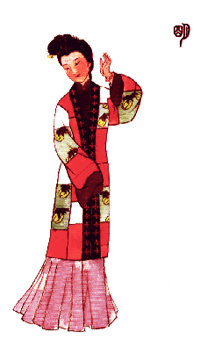
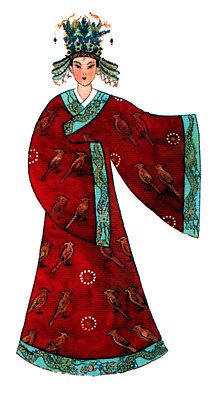
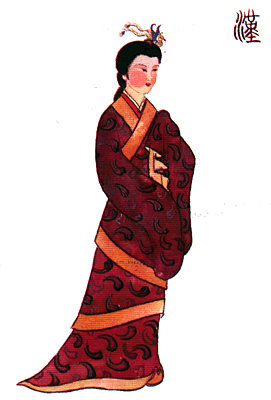
Following are Chinese styles worn throughout the dynasties: (source: http://pandagator.info/blog/?p=33)


Qin and Han:

Qin and Han


Tang:


Tang

Tang

Tang


Song:


SongSongSong


Yuan:


YuanYuan


Ming:


Ming MingMingMing


>> Read More...

Huang-di Yellow Emperor黄帝

"Huang di" also "Yellow Emperor", was one of the legendary Chinese emperors. Huang di was lived in about 2600BC, he was borned in XinZheng, Henan province, and buried at QiaoShan(also named as HuangLing, this was named after Hunag di), ShanXi province. It was said, Huang di was borned at the second day in the second month in Chinese Calendar.


Huang di was deemed as the main ancestor of all Han and some Minority nation. His victory in the war with Chi You at the Battle of Zhuolu is seen as the establishment of the Han Chinese nationality.

Chinese said, Huang di is the inventor of writing, the compass, the pottery wheel, and the breeding of silkworms(actually, this was said invented by Huand di's wife).


Huangdi has been credited with written (collaborated by his physician) "Huangdi Neijing (黄帝内經 Inner Canon of Huangdi)", the principles of Traditional Chinese medicine. However, modern historiographers generally consider this book to be compiled about 200BC, more than 2000years later.(But it doesn't means Huang di done nothing on medicine, the book was named after Huang di, it would be some kind of commemorate).

Huangdi Neijing


>> Read More...

Fuxi--- Creator of Trigrams Symbols


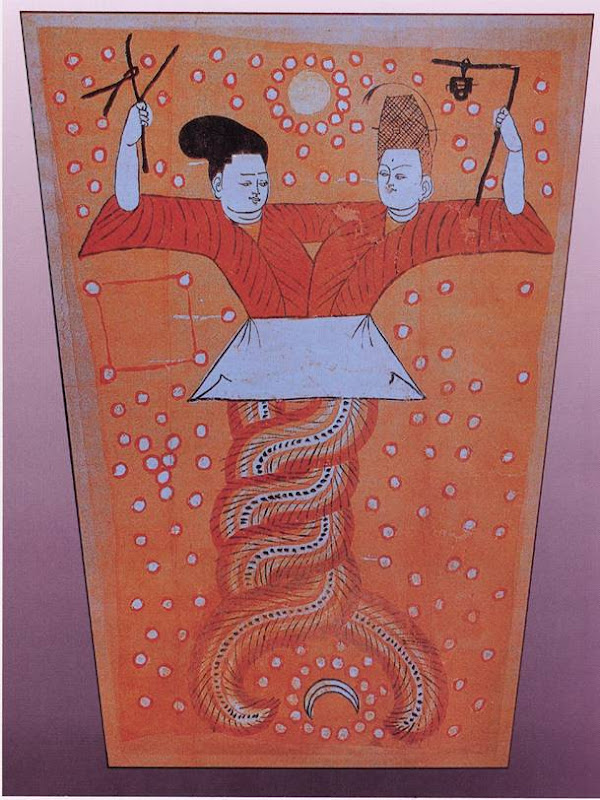
Fuxi, also Fu Hsi( 伏羲, 庖牺, 庖犧) is the legendary god in the mythology of ancient China. He is also called Taihao(太昊) or Taihao Fuxi. He was born in TianShui, GanSu province, and has a snake tails like his sister "Nv wa"


Legend says, by imitating the spider, he created a net to catch fish and animals. He invented the musical instrument, Se, a plucked instrument with 50 strings, and constituted the Eight Diagrams used in divination. He married his younger sister, Nv wa, and started the reproduction of offspring one generation after another. Thus they became the ancestors of the Chinese.


Fuxi and Nv wa (portrait found in old tomb in AShiNa XinJiang province)


It was say, one day, a dragon horse emerged from the Yellow River, Fuxi invented "He Tu"(means River Picture) according to marks on its back. Then Fuxi invented the arrangement of the Trigrams (八卦 bāgùa). Because "He Tu" and Trigrams was seemed as a very important core part of Chinese culture, so Fuxi was seemed as the beginner of Chinese culture.


Dragon Horse(loong ma 龙马)


River Picture(He Tu, 河图)


In the Han Dynasty (206 B.C. - 220), Fu xi and Nv wa were carved on stone as figures with both human heads and bodies of the snake. They are human-shaped from the waist up, but are snake-like below. The lower bodies are entangled together with each other.


>> Read More...

Qi xi jie --- A Chinese Valentine's Day

The Qi Xi Jie occurs on the 7th Day of the 7th Month of the Chinese Calendar.

As any Chinese grandmother will tell you, the ancient celebration of true love dates back centuries when Zhinv (织女 Weaving Girl) fell in love with a young farmer named Niulang(牛郎 cow boy) at NanYang, HuBei province. Sadly, there is a classic complication - our heroine here is the granddaughter of the Lady Queen WangWuNiangNiang!


Even though the law strictly forbids relationships between mortals and immortals, the rebellious young couple fall in love and eventually marry anyway - when the unthinkable happens, and they has a girl and a boy. Upon the discovery of their relationship, the Lady Queen WangWuNiangNiang forces Zhinv to return to heaven, never to see Niulang again.


But Niulang refuses to give up. He was helped by a old cow, flies to Zhinv's side (with the help of a magic ox) only to have the Lady Queen WangWuNiangNiang then uses a hairpin to draw the Milky Way across the sky to separate the couple forever.

And after that Zhinv and Niulang must separated for 364 days of a year - except for Chinese Valenine's Day - when the Lady Queen WangWuNiangNiang takes pity on them by sending a flock of magpies to bridge the gap between the lovers and reunite them. (and then magpies was seemed as a bode well to lovers and couples)

In Chinese, "7" pronounced Qi, and this pronounciation also means "fantastic", so "the 7th Day of the 7th Month" is the most fantastic day in the year, so an old times, In the night of Qi xi jie, girls and ladys gazing stars and prays to be smart and skillful, and prays for a happy marriage.

This folktale was started about 2000 years before at Han Dynaty.

Today, on Chinese Valentine's Day, school children are asked to search the heavens where Zhinv can be found in the star Vega east of the Milky Way, and for her beloved Niulang, who steadfastly waits for her in the constellation Aquila, west of the Milky Way.

According to legend, on Chinese Valentines Day magpies can scarcely be seen, since they are spreading their wings to form the bridge in the heavens to reunite the couple once again. The evening of Chinese Valentine's Day is traditionally reserved for star gazing, and the classic retelling of the tale of Zhinu and Niulang.


>> Read More...

August 24, 2008

Nv Wa, Patches up the Sky(女娲补天)

Nv Wa(sometimes Nv Kua) was a female godess in Chinese lengend, she has a snake tails. and she was the creator of mankind.

After Pangu create the world, the earth was a beautiful place with blossoming trees and flowers, and full of animals, birds, fish and all living creatures. But as Nv Wa wandered about it Nv Wa felt very lonely. She pick up a handful of yellow clay near Yellow River, mixed it with water and molded a figure in her likeness. As she blowing to it, the figure came alive -the first human being. Nv Wa was so pleased with her creation that she went on making more figures both men and women. They danced around her cheerily and loneliness was dispelled.

Nv Wa is defined in China earliest dictionary by the philologist Xu Shen ( c.58-147) as being " in charge of breeding of all living things", so possibly her origin is associated with fertility.

Nv Wa was the sister and then the wife of Fu Xi, the legendary ruler who was credited with teaching man to domesticate animals and to have taught people matrimony.

Second, Nv Wa patched up the sky.

Two deities, called in Gong Gong, the God of Water and Zhu Rong, the God of Fire, were in battle. They fought all the way from heaven to earth, causing turmoil everywhere. The God of Fire won, and in anger the God of Water struck his head against Buzhou Mountain (a mythical peak supposed to be northwest of the Kunlun range in southern Xinjiang ). The mountain collapsed and down came the big pillar that held heaven from earth. Half the sky fell in, leaving a big black hole. The earth cracked open, forests went up in flames, floodwaters sprouted from beneath the earth and dragons, snakes and fierce animals leaped out at the people. Many people were drowned and more were burned or devoured. It was an unprecedented disaster.

Nv Wa was grieved that mankind which she had created undergo such suffering. She decided to mend the sky and end this catastrophe. She melted together five colored stones and with the molten mixture patched up the sky. Then she killed a giant turtle and used its four legs as four pillars to support the fallen part of the sky. She caught and killed a dragon and scared other beasts away. The she gathered and burned a huge quantity of reeds and with the ashes stopped the flood from spreading, so that the people could live happily again.

After disaster, the sky slanted to the northwest and the earth to the southeast, so since then, the sun, the moon and all the stars turn towards the west and all the rivers run southeast.

So Nv Wa was deemed as the mother of mankind, specially, the mother of Chinese.


>> Read More...

Pangu, Creator of the world(盘古开天地)


Pangu(盘古), also known as PunkGod in English. In Chinese legend, Pangu created the world by separating the initail formless chaos gas into the sky and the earth, the sky is Yan(阳).

It was said, in the beginning, the universe was like an egg and there was only formless chaos in the egg.

Pangu sleeping in the egg for over 18,000 years. Then one day, he woke up and cracked the egg into pieces. By separating the heavy and light parts of the egg, he created the sky and the earth. Pangu stood on the earth and held up the sky using his hands, and then he had grown with the sky until the form of the world for another 18,000 years. The distance from Earth and Sky at the end of the 18,000 years would have been 65,700,000 feet, or over 12,443 miles.

After that, Pangu died(or rest), and his body become part of the earth, says his breath became the wind; his voice the thunder; eyes become the sun and moon; his body became the mountains; his blood formed rivers; his muscles the fertile lands; his hair the stars and milky road; his fur the bushes and forests; his bones the valuable minerals; his bone marrows sacred diamonds; his sweat fell as rain.


So Chinese think Pangu as the creator of the universe, and the earlyest, strongest god, and the father of civilization.

The lengend of Pangu was first come out at Three Kingdoms (三國) period(about 220AD).


>> Read More...

/Duan Wu/; A Day in Memory of A Patriotic Poet "Qu Yuan"

The 5th day of the 5th month of Chinese Lunar Calendar is an important day for Chinese people. The day called "Duan Wu" (meaning Day of Right Mid-Day) is observed everywhere in China. This unique Chinese celebration dates back to earliest times and a number of legends explain its origins.


The best known story centers on a patriotic court official named Qu Yuan(340 BC-278 BC), of the State of Chu during Warring States Period more than 2,000 years ago. Qu tried to warn the emperor of an increasingly courrupt government, but fails. In a last desperate protest, he throws himself into the river and drowns. The State of Chu was soon annexed by the State of Qin.

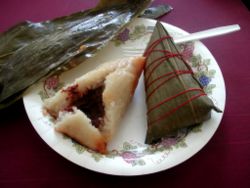
Later Qu Yuan's sympathizers jump into boats, beat the water with their oars and made rice dumplings wrapped in reed-leaves (zongzi) and scatter them into the Miluo River in the hope that fish in the river would eat the rice dumplings instead of the body of the deceased poet.

The custom of making rice dumplings spread to the whole country. Today, people eat glutinous rice cakes to mark the occasion.

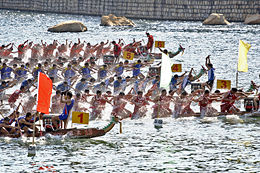
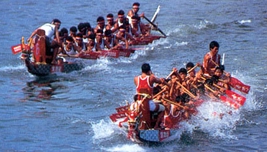
At the news of the poet's death, the local people raced out in boats in an efforts of searching his body. Later the activity became a boat race and the boats gradually developed into dragon-boats. In many places along rivers and on the coast today, the holiday also features dragon-boat races. In these high-spirited competitions, teams of rowers stroke their oars in unision to propel sleek, long vessels through the water.

It is more than 2,000 years since Qu Yuan departed. His poems are great additions to the wealth of the culture of the Chinese nation. They have been translated into a number of foreign languages and distributed worldwide. The World Peace Conference in 1953 listed him as one of the world’s top four famous literary persons on the day marking the 2230th anniversary of his death.


>> Read More...